

Reviewed by: Psychology Educator
Last Updated: March 2026
Introduction
Have you ever agreed to something even when you didn’t feel comfortable?
Maybe you didn’t want to share your phone. But
Maybe someone came too close.
Maybe you just didn’t know how to say no and just stayed silent and just let it happen…
If this familiar and confusing, then it’s completely normal!
Most teens go through this but don’t talk about it due to shame, judgement or lack of information.
That’s where personal boundaries for indian teens become important.
Something along side “boundaries” which every teenager should know about is Consent. Read here.
What Are Personal Boundaries (For Indian Teens)?
Personal boundaries are limits you set to protect:
- Your body
- Your emotions
- Your personal space
They define:
👉 what feels okay
👉 what doesn’t
Let’s take an example: If you don’t want anybody to touch you, you have to draw a boundary among your friends by saying: “Please keep your distance from me” or “Please give me some space”
Related: Going through your first periods? Here is what to expect!
Types of Personal Boundaries For Indian teens?
1. Physical Boundaries:
who can touch you and HOW
2. Emotional Boundaries
What you share with others
3. Digital Boundaries
What you share online
Why Do Boundaries For Indian Teens Matter
They help you:
- Stay safe
- Feel respected
- Avoid uncomfortable situations
According to the UNESCO, teaching boundaries improves safety awareness amng teenagers and grwoing young adults. Some may go their entire lve swithout learning about it.
👉 Learn: What is Puberty? The Complete Guide For Indian Teenagers
Real-Life Example oF Setting Boundaries for Indian Teens:
Let’s say – a friend keeps asking for your phone password. You feel uncomfortable but don’t want to upset them. Saying: “I’m not comfortable sharing that” is a boundary. A true friend will always accept your line and respect your boundary.
Anther example would be you and your partner decide to hold hands while strolling at a park. Baby steps of physical touch. The forst day went well. The nextday you didnt feel like it so, you communicate an set a boundary. You can say: “I dont feel like holding hands today. Can we we walk take a walk and talk today?”
Always remember your partner should be such that they respect your drawn boundary without any objections or opposition. This would be the gold standard for a emotionally compatible partner.
Related: Why does your voice changes during puberty? Here is the answer.
What It Looks Like Visually:
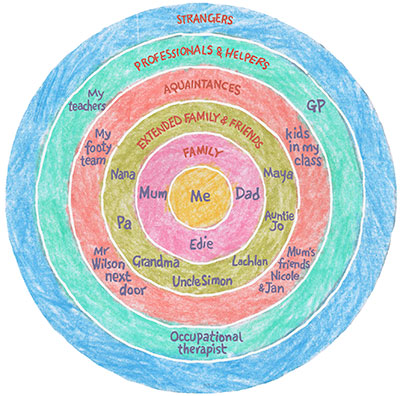
This image represnets the various levels of boundary which should be set in stone among family, relative, acquaintances and yourself.
What Does It Feel Like When Boundaries Are Crossed?
You may feel:
- Uncomfortable
- Pressured
- Confused
- Anxious
These feelings are your signal which you have to act on.
Something more: The Complete guide For Puberty For Indian BOYS
Your boundaries have been crossed. Now what?
Let’s say that someone has crossed your boundary which you have drawn. Now what is to be done?
Now, you have to reinforce your boundary and if, once again, it falls onto deaf ears, you are free to walk away from that circle of friends, family or strangers, without feeling a tinge of guilt.
Is This Normal?
Oh, yes. Absolutely.
Most teens:
- Struggle to say no
- Feel guilty setting boundaries
Don’t worry. You are not alone. With practice and repitition, everybody can become aware and more empowered
Something for parents: How Should Parents Talk About Sex/Safety To Thier Children?
How Long Does It Take to Learn Boundaries for Indian Teens?
- It takes time
- It improves with practice
Why Is It Hard To Set Boundaries For Indian Teens?
In India, from a young age we are taught to be obidient to elders. Many times. this obidience is also accompanied by subsurvience where we are not able to articulate our feelings explicitly due to fear of offending others.
Many teenagers might find it hard due to:
- Fear of hurting others
- Fear of judgment
- Not taught how
Dont Miss: What Is Good Touch and Bad Touch For Teenagers and Kids?
India Context
In India:
- Saying no is often seen as disrespect
- Teens are taught to “adjust”
This leads to:
- Silent discomfort
- Weak boundaries
👉 Learn more: the Complete Sex Education india Guide
What Is NOT Normal (Red Flags)
- Someone ignores your “no”
- You feel forced
- Repeated pressure
- Guilt manipulation
These are serious signs. These means that the perosn doesn’t respect your boundary and has no problem crossing it and making you feel unsafe.
When to Worry / Seek Help
Talk to:
- Parent
- Teacher
- Trusted adult
If:
- You feel unsafe
- Boundaries are repeatedly crossed
- You feel pressured constantly
Myths vs Facts (India-Specific)
Myth: Saying no is rude
Fact: It is self-respect
Myth: You must always adjust
Fact: Healthy relationships need boundaries
Myth: Only strangers cross limits
Fact: Often known people do
How to Set Boundaries (Actionable)
Now, here is how you set boundaries, given in actionable steps:
1. Be Clear
First: be clear whle setting boundaries. Assert in clear speech: “I’m not comfortable with that.” Be resolute.
2. Keep It Short
No long explanations needed post setting boundary. You don’t have to give justifications. You have a right to feel what you feel.
3. Stay Calm
Confidence > aggression. Stay calm and confidently set your boundary.
4. Repeat
Consistency builds respect. Always reinforce your boundary at time adn time again. This is how respect is generated in eyes of third party.
5. Trust Your Feeling
If it feels wrong, it probably is. Your nervouse system and body knows what’s about to happen. This is also called instinct. Trust your instinct.
Saying No Without Guilt
You are allowed to:
- Say no
- Change your mind
- Protect your space
Always remeber, Saying no = self-respect
Parent Guidance
What NOT to do:
- Force children to hug
- Ignore discomfort
What TO do:
- Respect child’s “no”
- Teach boundaries early
- Encourage communication
IOZA Insight
Most Indian teens are taught obedience before awareness. That’s why boundaries feel difficult. But knowing how to set boundaries is one of the most important tools of social management in the lives of indian teenagers. Especially when A.I. , Internet and mobile phone rule the digital ecosystem which kids and teenagers are exposed to.
Thats why – confidently draw your boundaryand honour it.
Real confidence comes from:
- knowing your limits
- expressing them
Final thoughts – from Ioza: Reassurance
If setting boundaries feels hard:
You are not weak.
You are learning something most people are never taught.
FAQs
1. What are boundaries?
Bouundaries are Personal limits which you set for yourself.
2. Is saying no okay?
YES. saying NO is perfectly allright.
3. What if someone gets upset?
That’s okay. Thier emotions are not your responsiblity.
4. Can boundaries change?
Yes. If you feel it’s okay for someone to do something, which you earlier told them NOT to do, you can re-set the boundary as well.
5. Are they important?
YES. Boundaries are very important for growing indian teenagers.
Final Thoughts For Setting Boundaries For Indian Teens
Boundaries are not restrictions—they are protection. The earlier you learn them, the safer and more confident you become.
About the Author
Utkarsh Sinha is the CEO of IOZA Learning, where he develops age-appropriate sex education and student safety content for schools across India. His work focuses on topics such as body safety, puberty, consent, and digital safety, with an emphasis on clear, practical, and culturally relevant guidance for students, parents, and educators. This article has been developed in collaboration with the IOZA Learning Team, which includes certified educators and subject matter experts.